
When you start a business in South Africa, the checklist to get your feet off the ground is quite familiar. Register with CIPC. Get a tax number from SARS. Open a business bank account. Sort out a logo. Some advice may include building a website early on.
But the answer to the question of how much a website design costs in South Africa is not as straightforward as many business owners may hope.
So, How Much Does a Website Design Cost in South Africa?
The costs vary widely depending on the type of site, the features required, and who is building it. In 2026, a 5-page website can cost anywhere from R399 to R56,350 across different web designers, with an average of R6,254 for a standard 5-page site.
South Africa’s internet penetration reached 78.9% of the population (50.8 million users) by early 2025, and ecommerce orders grew 47% in 2025, which means a well-built website is no longer optional for most businesses. The question is how much of your budget to allocate and what you should expect to receive.
Quick Reference
| Website Type | Price Range (ZAR) | Build Time |
|---|---|---|
| DIY website builder (Wix, Squarespace) | R250 – R500/month | Self-managed |
| Template site from a freelancer | R5,000 – R15,000 | 1 – 2 weeks |
| Custom WordPress website | R15,000 – R50,000 | 3 – 6 weeks |
| Ecommerce website (WooCommerce/Shopify) | R25,000 – R80,000 | 4 – 8 weeks |
| Large ecommerce operation | R60,000 – R150,000+ | 8 – 16 weeks |
| Corporate / enterprise website | R80,000 – R200,000 | 10 – 20 weeks |
| Custom web application | R80,000 – R500,000+ | 3 – 12 months |
Want a quick estimate? Try our website calculator.
What Affects Website Design Cost in South Africa?
It is common for websites within the same business niche to cost differently. The difference always comes down to a consistent set of factors that every web designer or agency uses to scope a project. Understanding these factors puts you in a stronger position when reviewing quotes, allowing you to see what is driving the price up or what has been left out to make a quote appear cheaper.
Here are the eight factors that most directly affect what you will pay for a website in South Africa in 2026.
1. Number of Pages and Content Complexity
The main factor affecting cost is the number of pages and their complexity. A simple five-page site with Home, About, Services, Portfolio, and Contact is very different from a 30-page site with booking systems and multiple service categories. Most South African web designers include a set number of pages in their base package, with extra pages quoted separately.
Estimated cost impact: Each additional page beyond a base package typically adds R500 – R2,500, depending on the complexity of content and whether custom design work is required per page.
2. Custom Design vs Template
The choice between a custom-designed website and a template is one of the single biggest cost variables in any SA web project.
- Template-based sites (R2,500 – R10,000): The designer selects a pre-built WordPress or Shopify theme and customises it with your brand colours, logo, and content. Build time is faster (1–2 weeks) and the upfront cost is lower. The trade-off is that your site will share its structural design with potentially thousands of other websites.
- Custom-designed sites (R10,000+): A designer builds your layout from scratch, meaning every element is created specifically for your brand. This takes longer (3–8 weeks) but produces a more distinctive result and typically performs better for conversion and SEO.
Estimated cost impact: Choosing custom design over a template typically adds R10,000 – R30,000 to a project, depending on the number of unique page layouts required.
3. Platform and Technology
The platform your website is built on affects both the upfront build cost and your ongoing running costs. South African web designers most commonly build on:
- WordPress, The most widely used platform in SA; flexible, well‑supported locally, and compatible with SA payment gateways like PayFast and Peach Payments. Build costs typically range from R5,000 to R50,000+ depending on complexity, with ongoing hosting and maintenance on top.
- Shopify, Popular for ecommerce; lower development complexity but ongoing monthly subscription costs can go from approximately R270 – R1,700/month depending on the plan at the current ZAR/USD rate.
- Wix / Squarespace, Lowest upfront cost (typically R100–R500/month on DIY plans), but functionality is limited and monthly subscription costs accumulate significantly over time.
- Custom build, Used for complex web applications; highest build cost (typically R80 000–R500 000+ depending on scope) but required when standard CMS platforms cannot support the functionality needed.
Estimated cost impact: Platform choice can swing a project by R10,000 – R80,000 when comparing a simple DIY builder to a custom-built application.
4. Features and Functionality
Every feature your website needs to do beyond displaying information adds development time and cost. Common SA business website features and their approximate cost impact:
| Feature | Estimated Cost Add-on (ZAR) |
|---|---|
| Contact form (basic) | Included in most base packages |
| Blog setup and configuration | R1,500 – R3,500 |
| Booking / appointment system | R3,500 – R12,000 |
| Online payment (PayFast / Peach Payments) | R3,000 – R8,000 |
| Product catalogue (no checkout) | R5,000 – R15,000 |
| Full ecommerce checkout | R15,000 – R40,000+ |
| Membership / login portal | R10,000 – R35,000 |
| Multilingual support | R5,000 – R15,000 |
| Live chat integration | R1,000 – R3,000 |
The more your website needs to do, the higher the build cost, but also the greater the potential ROI if those features directly generate leads or sales.
5. Content and Copywriting
This is one of the most consistently overlooked cost factors in the SA market, and one of the most common sources of project delays. Web designers build the container; you (or a copywriter) fill it with words, images, and media. If you do not provide content, your designer either waits (extending the timeline) or charges to source or write it.
Professional copywriting in South Africa typically costs R650 – R2,500 per page for website copy, depending on the complexity of the brief and the experience of the writer. Photography (if you require a professional shoot rather than stock imagery) typically adds R3,000 – R15,000, depending on scope.
Estimated cost impact: A 5‑page website with professional copywriting and stock photography could add R5,000 – R12,500 to your total project cost.
6. Mobile Responsiveness
Over 68% of website traffic in South Africa comes from mobile devices. February 2026 StatCounter data shows Chrome for Android (53.17%), Safari on iPhone (9.12%), and Samsung Internet (5.76%) as the top SA browsers. Google ranks sites based on their mobile version, so a site that works on desktop but not on mobile affects SEO as well as usability.
Most professional SA web designers include mobile responsiveness as standard in 2026. However, a truly mobile-optimised build, where layout, navigation, image compression, and tap targets are designed specifically for mobile rather than simply scaled down from desktop, takes additional development time.
Estimated cost impact: Basic mobile responsiveness is typically included in packages.
7. POPIA Compliance
Any South African website that collects personal information, which includes contact forms, newsletter sign-ups, ecommerce checkouts, and even Google Analytics, is required to comply with the Protection of Personal Information Act (POPIA). POPIA requires, at minimum, a privacy policy, a data handling disclosure, and clear consent mechanisms for data collection.
The Information Regulator actively enforces POPIA, and fines for non-compliance can reach R10 million. POPIA regulations were further strengthened in April 2025, tightening requirements around marketing consent and data subject rights.
For websites, the practical cost of POPIA compliance falls into two categories:
- Privacy policy and consent notice: A professionally drafted POPIA‑compliant privacy policy from a South African legal firm costs R1,500 – R5,000. Template‑based solutions (reviewed and customised) cost R500 – R1,500.
- Technical implementation: Cookie consent banners, data collection disclosure notices, and opt‑in mechanisms for marketing emails require development time, typically R1,000 – R3,500 to implement correctly.
Estimated cost impact: Budget R2,000 – R8,500 for full POPIA compliance depending on whether you use a legal firm or a template solution.
8. Local Hosting and SA-Specific Infrastructure
Where your website is hosted directly affects its page speed for South African visitors and its ranking in local Google searches. A website hosted on a server in the United States or Europe will load slower for SA users than one hosted in a local data centre, and page speed is a confirmed Google ranking factor.
South Africa now has its own Google Cloud region based in Johannesburg, and major SA-based hosting providers like Xneelo, Afrihost, HostAfrica, and Domains.co.za offer shared and VPS hosting from R99 – R299/month, avoiding the currency exposure of international providers priced in USD.
For businesses in load-shedding-affected areas, hosting on a provider with generator backup or cloud redundancy is a practical consideration no international guide addresses, but one that directly affects your site’s uptime and your customers’ experience.
Estimated cost impact: Hosting is an ongoing expense rather than a one-time build cost (see the Hidden Costs section). Choosing a developer familiar with South African hosting providers who can optimise your site for local page speed is an important consideration when selecting a web designer.
Freelancer vs Web Design Agency vs DIY Builder: Which One Is Right for You?
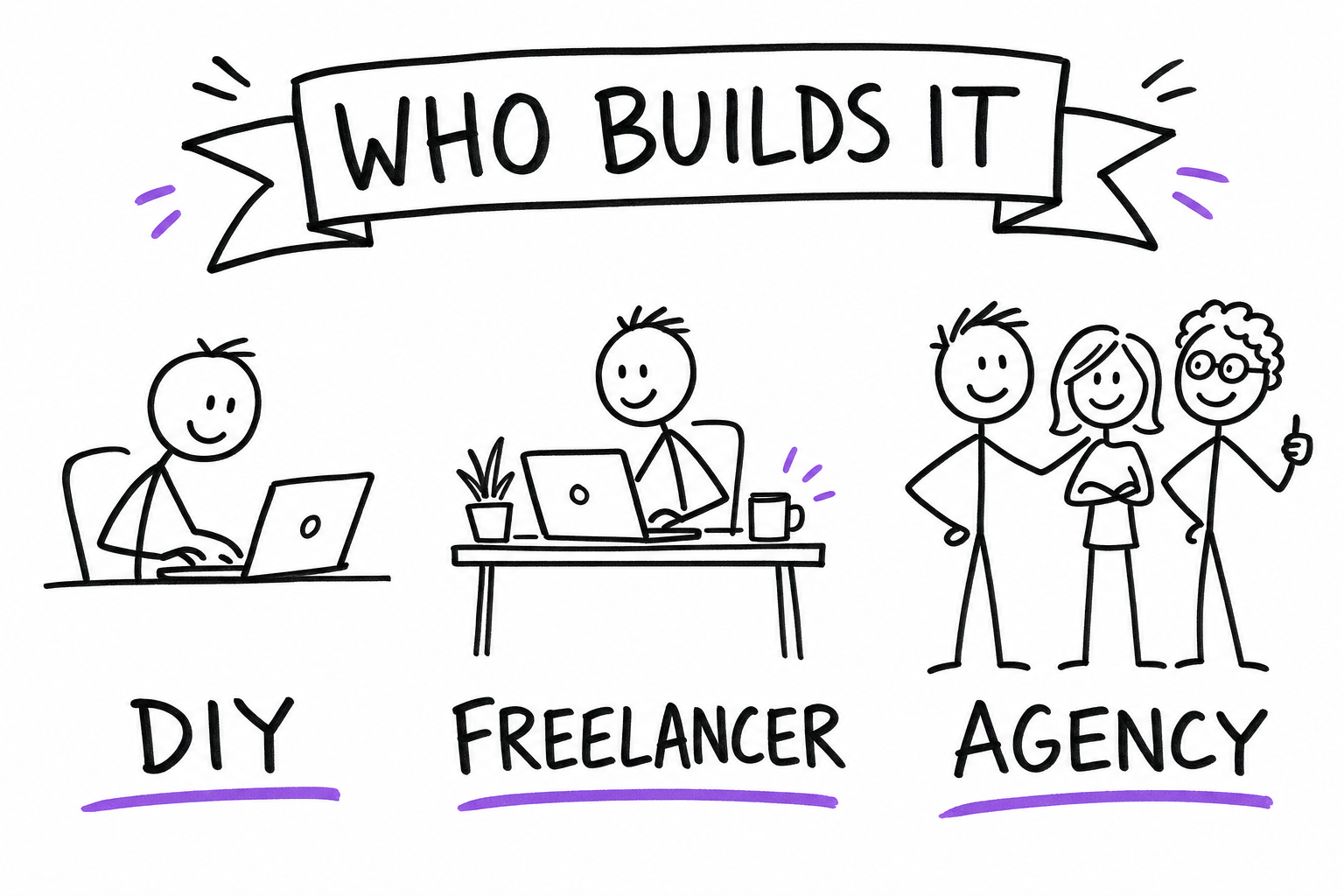
This is the question most business owners are actually trying to answer when they search for website costs in South Africa. The three paths are genuinely different products. Getting this decision wrong costs money in either direction: overpaying for agency-level work on a simple brochure site, or underpaying for a DIY build when you needed a revenue-generating ecommerce store.
Here is a direct comparison of all three, followed by a practical guide to which one fits your situation.
Side-by-Side Comparison
| DIY Website Builder | Freelancer | Web Design Agency | |
|---|---|---|---|
| Typical cost (ZAR) | R200 – R500/month ongoing | R5,000 – R45,000 once-off | R20,000 – R150,000+ once-off |
| Build time | Self-managed (days to weeks) | 1 – 6 weeks | 3 – 20 weeks |
| SEO performance | Weaker; builder-generated code is heavier and slower for Google to crawl | Variable; depends on freelancer’s SEO knowledge | Typically strongest; structured builds with clean code and SEO architecture |
| SA payment gateway support | Limited on free/lower plans; Wix requires a Business plan for PayFast | Most experienced SA freelancers can integrate PayFast or Peach Payments | Full integration as standard at agency level |
| Post-launch support | Platform support only; no personalised assistance | Varies; many freelancers offer ad hoc support at hourly rates | Usually includes a defined support period; some offer monthly retainers |
| Best for | Hobby sites, sole traders, brand-new businesses testing an idea | Startups and SMEs with clear briefs and budget discipline | Established businesses, ecommerce, corporate, or when the site is a primary revenue channel |
The DIY Website Builder Path
Platforms like Wix, Squarespace, and Shopify’s basic tier let you build and publish a website yourself without writing a line of code. Wix’s paid plans in South Africa start at approximately R295/month (Light plan, annual billing) and run to around R500/month for plans that support ecommerce and remove platform ads. Squarespace runs from approximately R295 to R720/month for its entry-to-mid tiers (Basic to Plus), with an Advanced plan at ~R1,800/month for high-volume commerce.
The key thing to understand about the DIY path is the long-term cost of ownership. Over three years, a Wix or Squarespace subscription costs approximately R10,600 – R18,000 in subscription fees alone for standard plans, and at the end of that period, you own nothing transferable. If you stop paying, your site disappears. You also cannot fully migrate your Wix site to another platform; a future rebuild would start from scratch.
This path makes sense when: You are testing a business idea and need a basic online presence quickly and cheaply. You have the time to build and manage it yourself. Your site is primarily informational with no complex functionality.
This path does not make sense when: You need ecommerce with SA payment gateways, a strong local SEO performance, a custom brand experience, or a site you plan to grow significantly in the next 2–3 years.
The Freelancer Path
A freelancer is a single independent professional, typically a designer, developer, or both, who takes on your project directly. In South Africa, freelancers range from junior developers charging R5,000 – R20,000 for a basic site to experienced specialists charging R15,000 – R45,000 for a more complex build.
The biggest advantage of a freelancer is the direct working relationship and lower overhead cost. Because a freelancer has no office rent, no full-time staff, and no project management layers, they can deliver comparable work at a lower price than an agency. For a straightforward WordPress brochure site or a small ecommerce build, a well-chosen freelancer often represents the best value in the SA market.
The risk is capacity and range. A single person is covering design, development, QA, SEO, and launch support simultaneously, and the quality across all those disciplines varies. If your freelancer gets sick, takes on a larger client, or simply disappears mid-project (a known risk), your project stalls with no backup.
This path makes sense when: Your project is clearly scoped, your content is ready to hand over, your budget is between R8,000 and R35,000, and you have time to verify the freelancer’s portfolio and references.
This path does not make sense when: You need a complex ecommerce build, multi-language support, API integrations, or an enterprise CMS, or when post-launch support and long-term accountability are critical.
The Web Design Agency Path
A web design agency brings a full team to your project: typically a project manager, UI/UX designer, front-end developer, back-end developer, and in some cases an SEO specialist or copywriter. This structure introduces overhead costs, salaries, office rent, project management tools, which is why agency pricing starts higher. In South Africa, boutique agencies typically charge R20,000 – R60,000, while mid-size agencies with fuller teams run R40,000 – R150,000+.
What you are paying for beyond the website itself is accountability, process, and depth of expertise across multiple disciplines at once. An agency is unlikely to disappear mid-project. They have documented processes for discovery, QA, and launch. They typically offer post-launch support periods and are reachable through multiple channels.
The trade-off is that agencies are not always the right fit for smaller budgets or simpler projects. A boutique agency will build a 5-page brochure site perfectly well, but you may be paying for capacity and team structure that your project does not actually require. Agencies also sometimes deprioritise smaller clients when a larger account demands attention.
This path makes sense when: You are building an ecommerce store, a corporate site, or a web application. Your website is a primary revenue or lead-generation channel. You need a full-service relationship, strategy, design, development, and ongoing support, rather than just a build.
This path does not make sense when: Your budget is under R15,000, your project is simple and well-scoped, and you are comfortable managing a direct freelancer relationship.
Quick Decision Guide
Not sure which path fits? Answer these four questions. Click an option to continue.
WordPress vs Wix vs Shopify for South African Businesses
The platform your website is built on has a significant long-term impact on your costs, your SEO performance, your ability to integrate SA payment gateways, and how well your site copes with South Africa’s unique infrastructure realities. This section covers the three dominant platforms in the SA market from an SA business perspective, not a generic global comparison.
Platform Cost Comparison (SA-Specific)
| WordPress | Wix | Shopify | |
|---|---|---|---|
| Platform cost | R0 (R5k–R12k/yr theme + plugins) | R495 – R830/month | R530 – R5,500/month |
| Hosting | Separate, R99–R400/month | Included | Included |
| SA payment gateways | Full, PayFast, Yoco, Peach, Ozow | PayFast + Yoco on Business plans | PayFast + Peach; no Shopify Payments in SA |
| SEO | Strongest, full code control | Limited, no code or schema access | Strong for ecommerce; weak for blogs |
| Load shedding | Depends on host, use SA providers | Cloud (US/EU), slower for SA | Global CDN, generally fast in SA |
| Best for | Most SA businesses | Hobby sites, sole traders | Dedicated ecommerce stores |
Verdict for SA Businesses
- Use WordPress if you are building a service business website, a content-driven site, or an ecommerce store where long-term SEO performance matters and you want full ownership of your platform.
- Use Shopify if ecommerce is your primary focus, your team is non-technical, and the convenience of an all-in-one managed platform justifies the higher monthly running cost in ZAR.
- Use Wix only for the simplest possible online presence, an informational site, a creative portfolio, or a short-term business testing an idea, where scalability and SEO are not immediate priorities.
Hidden Website Design Costs South African Businesses Overlook
The price your web designer quotes you mostly covers the build. What most quotes do not include, and what most business owners do not budget for, is the ongoing cost of running, maintaining, and growing a website after launch. A website is not a once-off purchase; it is an operational asset with recurring costs.
Here are the ten cost items most commonly missing from SA web design quotes:
1. Domain Registration
Your domain name (e.g., yourbusiness.co.za) must be registered annually. A `.co.za` domain costs approximately R100 – R250/year through SA registrars; a `.com` domain costs R200 – R500/year. Some web designers include the first year’s domain in their package, confirm this in writing, and ensure the domain is registered in your name, not theirs.
Estimated annual cost: R100 – R500
2. Website Hosting
Your website lives on a server that must be paid for continuously. Shared hosting for a standard WordPress site costs R99 – R400/month through SA providers like Xneelo and HostAfrica (entry-level VPS plans start from ~R200–R800/month for higher-traffic sites). Entry-level shared hosting from Xneelo starts at R99/month with a free SSL certificate, daily backups, and 99.9% network uptime included as standard. Note that HostAfrica prices in USD, so their rand equivalent will fluctuate with the exchange rate.
Estimated monthly cost: R99 – R500/month depending on traffic volume and performance needs
3. SSL Certificate
An SSL certificate encrypts data between your website and visitors and is a lightweight but confirmed Google ranking signal. Most SA hosting providers now include a free Let’s Encrypt SSL as standard. Premium SSL certificates for ecommerce or enterprise sites can range from R200 to R9,000+/year, depending on the validation level (DV, OV, or EV) and whether wildcard or multi-domain coverage is needed.
Estimated annual cost: R0 (if included with hosting) to R2,000
4. POPIA Compliance
Any SA website collecting personal data, contact forms, newsletter sign-ups, ecommerce checkouts, must comply with the Protection of Personal Information Act (POPIA), which was further strengthened by amended regulations in April 2025. This requires a privacy policy and data processing disclosure; while POPIA does not explicitly mandate cookie banners, implementing one is considered best practice given that cookies qualify as personal identifiers under the Act.
A professionally drafted POPIA privacy policy from a South African legal firm typically costs R1,500 – R6,500 (standalone policy to full compliance pack); a customised template costs R500 – R1,500. Technical implementation of a cookie consent banner adds R1,000 – R3,500 once-off, plus potential ongoing CMP subscription costs.
Estimated once-off cost: R500 – R8,500
5. Website Maintenance and Security
WordPress websites require regular plugin updates, security patches, and backups. Neglecting this leaves your site vulnerable, Wordfence recorded 1.6 million attacks on WordPress sites in just 48 hours in 2025, and South African SME sites are actively targeted. Monthly maintenance packages from SA web designers typically cost R399 – R3,000/month depending on the level of service. At minimum, ensure your hosting provider includes daily automated backups, Xneelo does include them as standard, though it recommends keeping a separate remote backup as well.
Estimated monthly cost: R399 – R3,000/month
6. Professional Copywriting
Content is rarely included in web design quotes. If you cannot write your own website copy, professional South African copywriters charge around R650 – R2,500 per page. A 10-page website with professional copy adds R6,500 – R25,000 to the total project cost, often matching the design cost itself.
Business owners can reduce this expense by using free generative AI tools, such as ChatGPT, Gemini, or Claude, but achieving high-quality copy requires strong prompt engineering skills.
Estimated once-off cost: R650 – R2,500 per page
7. Photography and Visual Assets
Stock photography licences from paid libraries like Shutterstock or iStock start at approximately R530/month for 10 images (billed annually, at current exchange rates) and scale upward depending on volume and licence type. Free options, Unsplash and Pexels, are available at no cost with no subscription required. A professional photography shoot for a Cape Town or Johannesburg business adds R3,000 – R15,000 depending on scope and photographer experience (enterprise commercial shoots can exceed this).
Estimated cost: Free (stock) – R15,000+ (professional shoot)
8. Professional Email Hosting
A professional email address ([email protected]) requires separate email hosting unless included in your web hosting package. Google Workspace (including Gmail, Drive, Meet) currently costs R170 – R530+/user/month (excl. VAT) from South African resellers, following a 2025 price increase. Microsoft 365 Business plans are broadly comparable, starting from approximately R130 – R255/user/month. Many SA web designers do not include email hosting in their quotes, so confirm this upfront.
Estimated monthly cost: R130 – R390+/user/month (incl. VAT, entry to standard tier)
9. SA Payment Gateway Fees (Ecommerce Only)
If your website takes payments, every transaction carries a fee. Current verified rates for South Africa’s main gateways:
| Gateway | Monthly Fee | Transaction Rate | Best For |
|---|---|---|---|
| PayFast | R0 | 3.2% + R2.00 (cards); 2% min R2.00 (Instant EFT) | SMEs, fast setup |
| Yoco Online | R0 | 2.95% (up to R100k/mo) to 2.55% (R100k–R200k/mo); 2.00% (EFT) | Card-first, mobile businesses |
| Peach Payments | Custom (enterprise pricing) | ~2.95% + R1.50 | High-volume, enterprise |
| Ozow | R0 | 1.5% min R1.00 (Pay By Bank/EFT Standard); Enterprise custom | EFT-heavy stores |
10. SEO and Digital Marketing
A technically excellent website that nobody finds is a wasted investment. Ongoing search engine optimisation in South Africa typically costs R3,000 – R80,000+/month depending on the scope, competitiveness of your industry, and the agency’s experience. A basic local SEO setup, Google Business Profile, structured data, and 2 blog posts per month, runs R3,000 – R8,000/month from most SA agencies, though at this budget level you’re typically getting advisory support and light maintenance rather than a full-execution campaign. Serious national or ecommerce SEO campaigns start at R15,000–R30,000/month.
Freelance SEO specialists charge R500 – R1,500/hour for consulting or project work, with some offering monthly retainers from R3,000 – R10,000/month. Freelancers often deliver outputs similar to boutique agencies but with lower overhead. They suit SMEs seeking hands-on, direct engagement. Vet candidates by requesting local case studies and Google Search Console results.
DIY SEO has no tool costs but requires significant time and effort. Expect 3–6 months of consistent learning before seeing meaningful results. Use Google’s free tools, Search Console, Google Business Profile, and PageSpeed Insights, along with resources like Google’s SEO Starter Guide. Basic tasks, such as optimising page titles, adding structured data, and building local citations, are learnable without coding skills. Content strategy, technical audits, and link building require more expertise. DIY works best for single-location businesses in low-competition niches. Competitive metros like Cape Town or Johannesburg typically need professional support for meaningful results.
Estimated monthly cost:
- DIY: R0 (tools free; time investment only)
- Freelancer: R3,000 – R10,000/month (or R500 – R1,500/hour)
- Agency (local/starter): R3,000 – R8,000/month Agency
11. WordPress Theme and Plugin Renewals
WordPress itself is free, but a professional business site runs on a premium theme and several paid plugins for SEO, security, backups, and forms. A standard SA business WordPress site using 3–4 paid plugins should budget approximately R5,000 – R12,000/year in theme and plugin renewal costs on top of hosting. There are also well-rated free themes and plugins available. These can be used to test functionality before committing to separate paid plugins or upgrading to premium versions.
Red Flags When Getting Web Design Quotes in South Africa
Not every web designer or agency in South Africa will deliver what they promise. Here are the warning signs that experienced SA business owners learn to recognise, including several that are specific to the local market.
1. No discovery process before quoting
A web designer who sends you a price without asking detailed questions about your business goals, audience, required functionality, and content volume is guessing. An accurate quote requires understanding actual scope. A generic quote with no discovery is either inflated to cover unknowns or underpriced because key requirements were not identified.
2. No line-item breakdown
A quote that says “Website, R25,000” without itemising pages, revisions, features, and post-launch support tells you nothing. Always request a written scope of work document before signing. The scope should specify exactly what is included, and what is not.
3. Pricing far below the market floor
A custom WordPress business site for R3,500 is not a bargain. At South African labour rates, quality custom development has a cost floor below which professional execution is not financially viable. Prices significantly below market typically indicate an offshore build with no SA payment gateway knowledge, a template with your logo placed on it, or a project that will stall mid-way.
4. Full payment required upfront
Established SA web designers and agencies work on a structured payment schedule, commonly 50% deposit, 25% at mid-project sign-off, and 25% at launch. Any provider demanding 100% payment before work begins should be treated with caution.
5. No mention of post-launch support
What happens when something breaks two months after launch? What is the process for requesting content updates? Agencies that do not address post-launch support in their proposal are signalling that support will be expensive, slow, or effectively non-existent.
6. No POPIA policy offered
Any SA website collecting data from customers needs a POPIA-compliant privacy policy and consent mechanism. A web designer building a site in 2026 without mentioning POPIA either does not understand the legal requirement or is deliberately leaving it out to cut scope. Either way, the compliance liability falls on you as the business owner.
7. Portfolio with no live, verifiable SA client work
Always click through the portfolio links. If no live websites are linked, or if the “portfolio” consists only of screenshots, ask for live URLs you can visit and verify. An inability to provide three live, currently operating SA client websites is a significant red flag.
Want a firm number for your exact site?
We build websites for South African small businesses at a fair, itemised price, with no surprises. Start with a free quote.
Frequently Asked Questions About Website Design Costs in South Africa
How much does a 5-page website cost in South Africa in 2026?
A 5-page website in South Africa costs between R5,000 and R25,000 depending on whether it uses a template or custom design. The SME Rocket 2026 agency survey found an average quoted price of R6,633 for a standard 5-page site across the SA market, though quality custom-designed 5-page sites from reputable designers typically start at R12,000 – R18,000.
Is WordPress or Shopify better for South African businesses?
WordPress is generally the better choice for SA service businesses and content-driven sites, it has stronger SEO performance, full SA payment gateway support (PayFast, Yoco, Peach Payments, Ozow). Shopify is better for dedicated ecommerce stores where product and order management is the primary function.
How long does it take to build a website in South Africa?
Build times vary significantly by project type: a landing page takes 3–7 days, a brochure site takes 2–4 weeks, a custom WordPress business site takes 3–6 weeks, and an ecommerce store takes 4–16 weeks depending on complexity. The most common cause of delays is not the designer, it is waiting for content (copy, photos, product descriptions) from the client. Having your content ready before the project starts can cut the timeline by 30–50%.
Do I need POPIA compliance for my website?
Yes, if your website collects any personal information from South African users, including contact form submissions, email newsletter sign-ups, Google Analytics tracking, or ecommerce checkout data. POPIA requires a privacy policy, data handling disclosure, and clear consent mechanisms. Non-compliance exposes you to fines of up to R10 million from the Information Regulator. Compliance costs range from R2,000 – R8,500 for implementation.
Can I build a website myself for under R5,000 in South Africa?
Yes, a DIY website on Wix or Squarespace can be built for under R5,000 in the first year, including domain registration and your platform subscription.
What is the cheapest way to get a website in South Africa?
The absolute cheapest way is a DIY Wix or Squarespace site, costing R100 – R250/month. The cheapest way to get a professionally built website is to hire a junior freelancer to set up a WordPress template site.
What should be included in a web design quote in South Africa?
A professional web design quote should include: number of pages, design approach (custom or template), platform and hosting recommendations, number of revision rounds, content responsibilities (who provides copy and images), mobile responsiveness, basic on-page SEO setup, POPIA compliance, post-launch support period and terms, and payment schedule. If any of these items are absent, ask before signing.
How much does website maintenance cost per month in South Africa?
Website maintenance in South Africa typically costs R500 – R3,000/month depending on the complexity of the site and the scope of the maintenance agreement. A basic maintenance package (plugin updates, security patches, uptime monitoring, monthly backup verification) costs R500 – R1,000/month. A full-service retainer including content updates, SEO monitoring, and priority support costs R2,000 – R5,000/month.