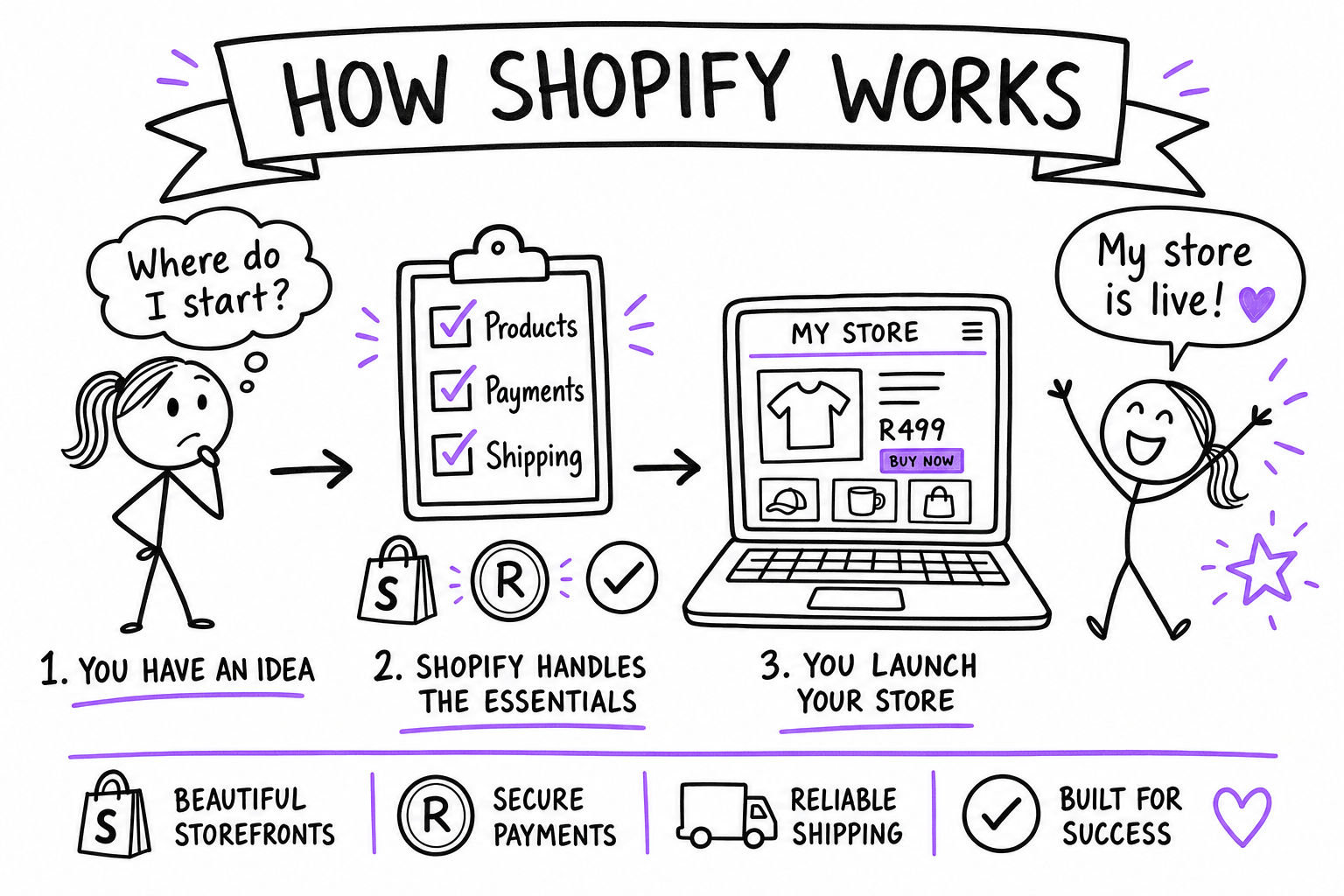
More and more South African businesses are selling online — but if you've looked into it, you've probably hit the same wall: everyone says "just use Shopify," and almost nobody explains what that actually means for a business here, in rand, with our local payment options.
So let's clear it up. In layman's terms, Shopify is a monthly subscription that runs your online shop for you — it hosts your store, keeps it secure, and gives you everything you need to sell. The one local catch is that Shopify's own payment system doesn't work in South Africa, so you plug in a local option like PayFast or Yoco instead.
This guide walks through exactly how Shopify works here — what it is, what it really costs in rand, how you get paid, where VAT fits in, and who handles what — so you can decide whether it's the right fit for your business.
What is Shopify, in simple terms?
Shopify is a hosted e-commerce platform. "Hosted" simply means your shop lives on Shopify's computers, not yours — so you never have to buy web hosting, install security certificates, or deal with software updates. Shopify handles all of that in the background.
According to Shopify's pricing page, every plan includes secure hosting and bank-level (PCI) security, and Shopify's security docs confirm each store gets a free SSL certificate — the padlock in the browser bar — installed and renewed automatically.
What you get is a ready-made online shop: a storefront you can brand, a place to list your products, a cart and checkout, and a simple dashboard to manage orders. You're not building a website from scratch — you're moving into one that already works, and making it yours.
How Shopify works, step by step
Here's what actually happens when you set up a Shopify store:
- You pick a plan and pay monthly. That's your "rent" (prices below).
- You choose a theme. A theme is the look of your shop — colours, layout, where things sit. You swap in your logo and brand.
- You load your products. Photos, descriptions, prices, stock — all added in a simple admin dashboard.
- You connect a payment gateway. This is how you get paid (the South African part matters here — see below).
- You set up shipping and tax, then open the doors.
Shopify keeps the shop online, fast and secure. You focus on what you sell.
How much does Shopify cost in South Africa?
Shopify bills in US dollars, so your rand cost moves with the exchange rate. According to Shopify's official pricing page (checked June 2026), the plans are (rand figures are approximate at ~R18.50 to the dollar):
| Plan | Monthly (USD) | Approx. per month (ZAR) | Best for |
|---|---|---|---|
| Basic | $25 | ~R460 | Solo owners getting started |
| Grow (used to be "Shopify") | $65 | ~R1,200 | Small teams |
| Advanced | $399 | ~R7,400 | Bigger, growing stores |
| Plus | from $2,300 | ~R42,500+ | Large/enterprise |
Plan prices per Shopify's pricing page, June 2026 — annual billing works out cheaper per month.
Two things South African owners should know:
- You pay 15% VAT on your Shopify bill. Shopify's billing help docs confirm South African stores are charged VAT on their subscription — and adding a VAT number doesn't remove it.
- There's a small extra transaction fee. Because you'll use a local payment gateway (next section), Shopify's pricing page shows it adds a fee of 2% on Basic, 1% on Grow and 0.6% on Advanced.
The big South African catch: Shopify Payments isn't available here
This is the one thing that trips up almost every SA store owner.
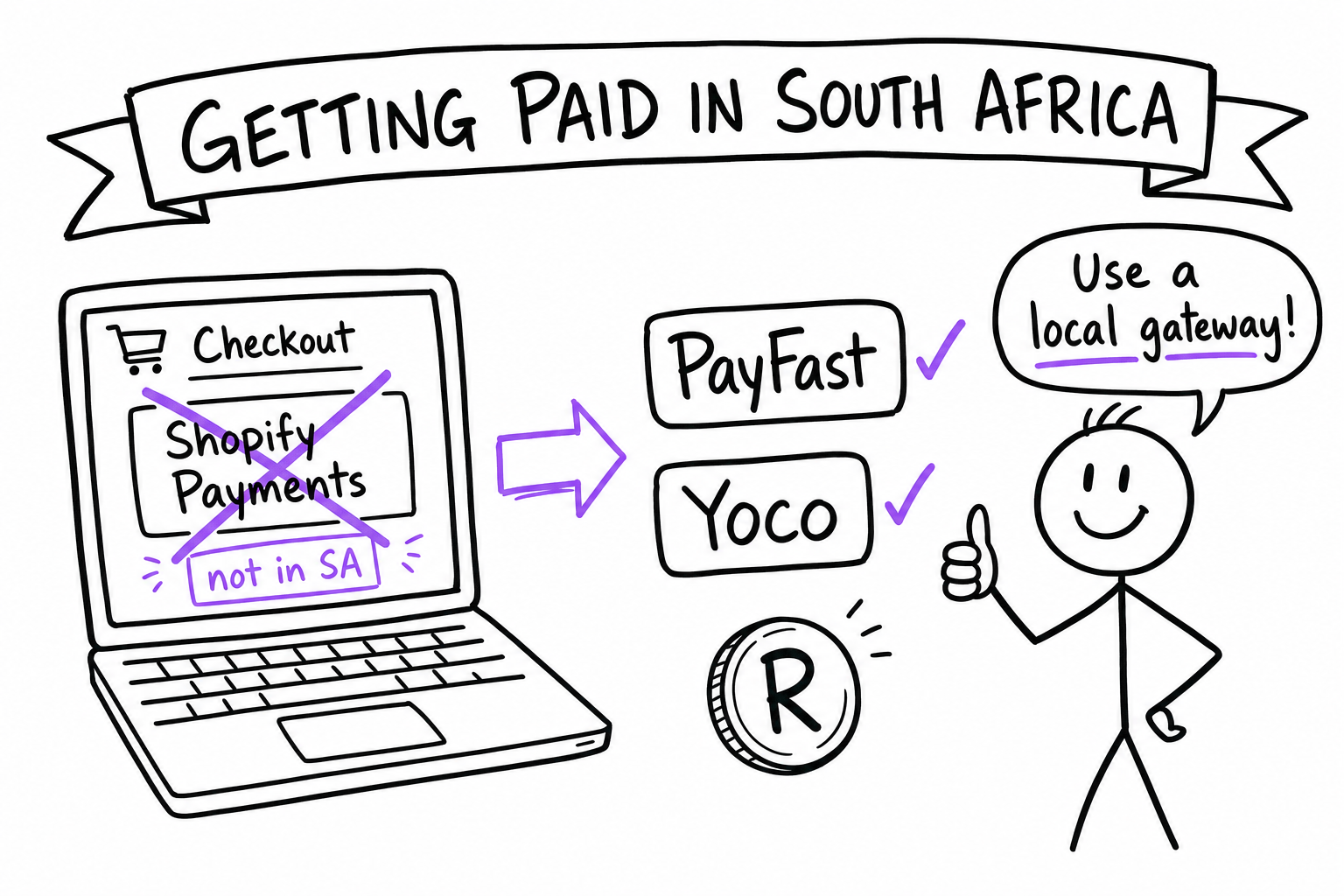
Shopify has its own built-in payment system called Shopify Payments — but it doesn't work in South Africa. Shopify's official list of supported countries doesn't include South Africa, and Shopify's own guidance is that if your country isn't listed, you use a third-party gateway instead.
That's not a dealbreaker — it just means you connect a local payment gateway. The main options that plug straight into Shopify:
| Gateway | Takes | Rough fee (confirm live) |
|---|---|---|
| PayFast | Cards, Instant EFT, SnapScan, Zapper, Apple/Samsung Pay — rand only | ~3.2% + R2 per card sale |
| Yoco | All major cards | 2.95% → 2.55% by turnover |
| Peach Payments | Cards + local methods | next-day settlement |
| Ozow | Instant EFT (bank to bank) | fast settlement |
Fees above are from PayFast and Yoco — gateways change their rates, so confirm the current numbers before you commit.
The only downside: because you're not using Shopify Payments, Shopify adds that small extra transaction fee on top of your gateway's normal rate. It's usually a rand or two on a sale — worth knowing, not worth losing sleep over.
What about VAT and tax?
Two separate things:
- On your Shopify bill: you pay 15% VAT (above).
- On your sales: once your business is VAT-registered, you charge customers 15% VAT, set up in Shopify's tax settings — as Shopify's billing help docs explain.
South Africans expect prices shown VAT-included, so it's worth setting this up correctly from day one.
Is Shopify popular in South Africa?
Yes, and it's growing fast. According to store-tracking data from StoreLeads, there were around 22,656 live Shopify stores in South Africa in mid-2026 — up about 28% year-on-year.
WooCommerce still powers more SA stores overall, but Shopify is the easiest hands-off option — which is why so many owners who don't want to manage the tech choose it.
Who handles what?
Here's where people get confused — so here's the clear version:
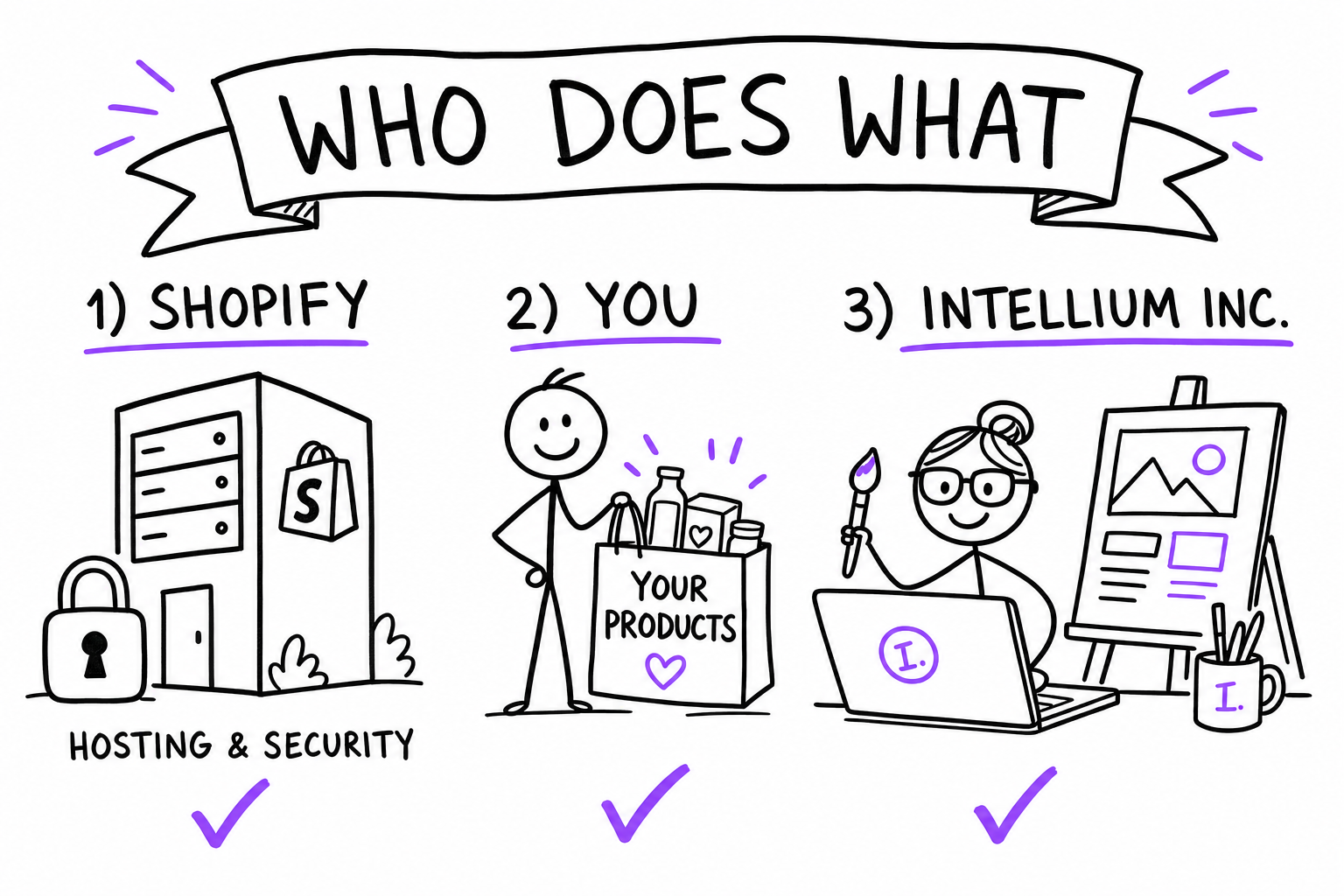
| Job | Shopify | You | A web partner like Intellium Inc. |
|---|---|---|---|
| Hosting, security, SSL, updates | Done for you | — | — |
| Store design & branding | Gives you themes | Could DIY | Custom build |
| Loading products & photos | Gives you the tools | Could DIY | Done for you |
| SA payment gateway setup | Gives the connection | Could DIY | Set up & tested |
| POPIA (privacy, cookie consent) | — | Your legal duty | Built in |
Shopify keeps the lights on and the doors locked. We design the shop, stock the shelves, wire up your South African payments, and make it POPIA-safe — so you just run the business.
Is Shopify right for your South African business?
Shopify is a great fit if you want to sell products online without managing the tech yourself. It's reliable, secure, works in rand, and connects to local payment options. The trade-offs are the monthly fee (in dollars) and the small extra transaction fee from using a local gateway.
If you'd rather not wrestle with themes, product loading and payment setup, that's exactly what we do.
Thinking about a Shopify store?
We build Shopify stores for South African businesses — design, products, SA payment gateways and POPIA-compliant checkout, from R4,500.
Frequently asked questions
Is Shopify good in South Africa?
Yes. It works in SA, supports rand, and connects to local gateways like PayFast and Yoco. The only catch is that, per Shopify's supported-countries list, Shopify Payments isn't available — so you pay a small extra transaction fee on top of your gateway's fee.
How much is Shopify per month in South Africa?
According to Shopify's pricing page, from about $25/month (~R460) on Basic, $65 (~R1,200) on Grow, and $399 (~R7,400) on Advanced — plus 15% VAT on your bill. Annual billing is cheaper.
Do you need a developer to use Shopify?
No — Shopify is built for non-technical owners. But a partner saves you time and gets the design, product loading, payment setup and POPIA compliance right the first time.
Is Shopify legit?
Yes. As Shopify's security docs show, it's a global platform with bank-level security and a free SSL certificate on every store.