At some point, every business owner reaches the same crossroads.
You know SEO could help you get found on Google. You've read the guides, watched a few videos, and maybe even received a handful of sales pitches. But now comes the real question:
Should you do SEO yourself, hire a freelancer, or bring in an agency?
The answer isn't as simple as "agencies are better" or "DIY is cheaper." Each option comes with different costs, trade-offs, risks, and expected results. What makes sense for a one-person business in Somerset West may be completely wrong for a growing e-commerce store competing nationally.
And because SEO is a long-term investment, choosing the wrong path can cost you more than money — it can cost you months of lost progress.
In this guide, we'll compare DIY SEO, freelancers, and SEO agencies from a South African perspective. We'll look at what each option actually involves, realistic costs in rands, the pros and cons of each approach, and how to decide which one fits your business right now.
By the end, you'll know exactly where your budget is best spent — and whether you're ready to tackle SEO yourself or bring in outside help.
If you're new to search engine optimisation, start with our complete beginner's guide: What Is SEO? A Plain Guide for South African Businesses. You'll learn how SEO works, why it matters, and what results to realistically expect.
The three ways to get SEO done
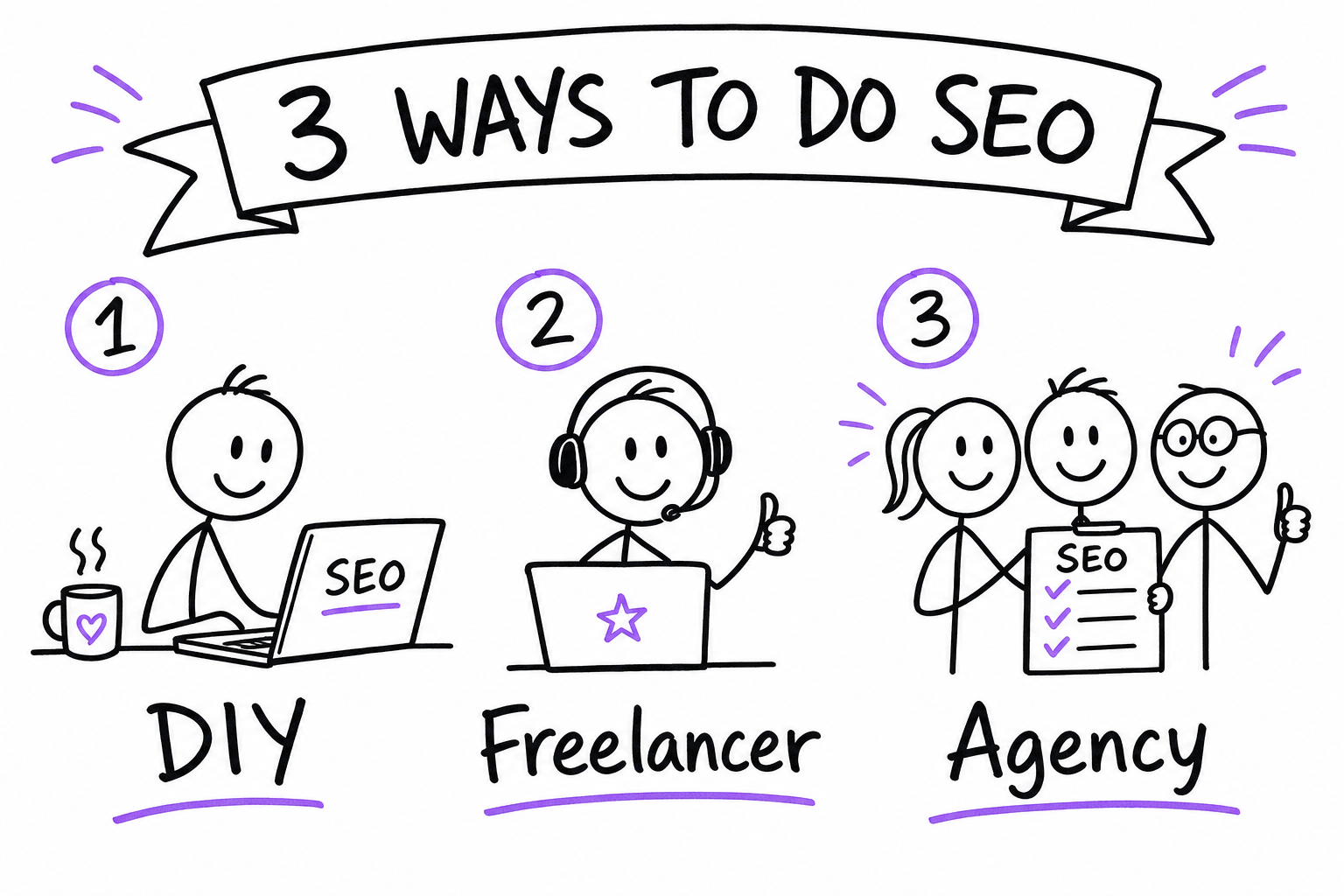
There are three realistic ways to handle seo for a small business:
- DIY SEO — you (or someone on your team) do everything: technical fixes, on-page work, content, links and tracking. Full control, no monthly fee, but it's essentially a part-time job.
- An SEO freelancer — one skilled specialist you hire, usually on a monthly retainer. Personal, flexible and affordable, with the limits of one person's time.
- An SEO agency — a team with different specialists (technical, content, links, reporting) working in parallel. The broadest service and fastest execution, at the highest cost.
DIY SEO: what you can do yourself
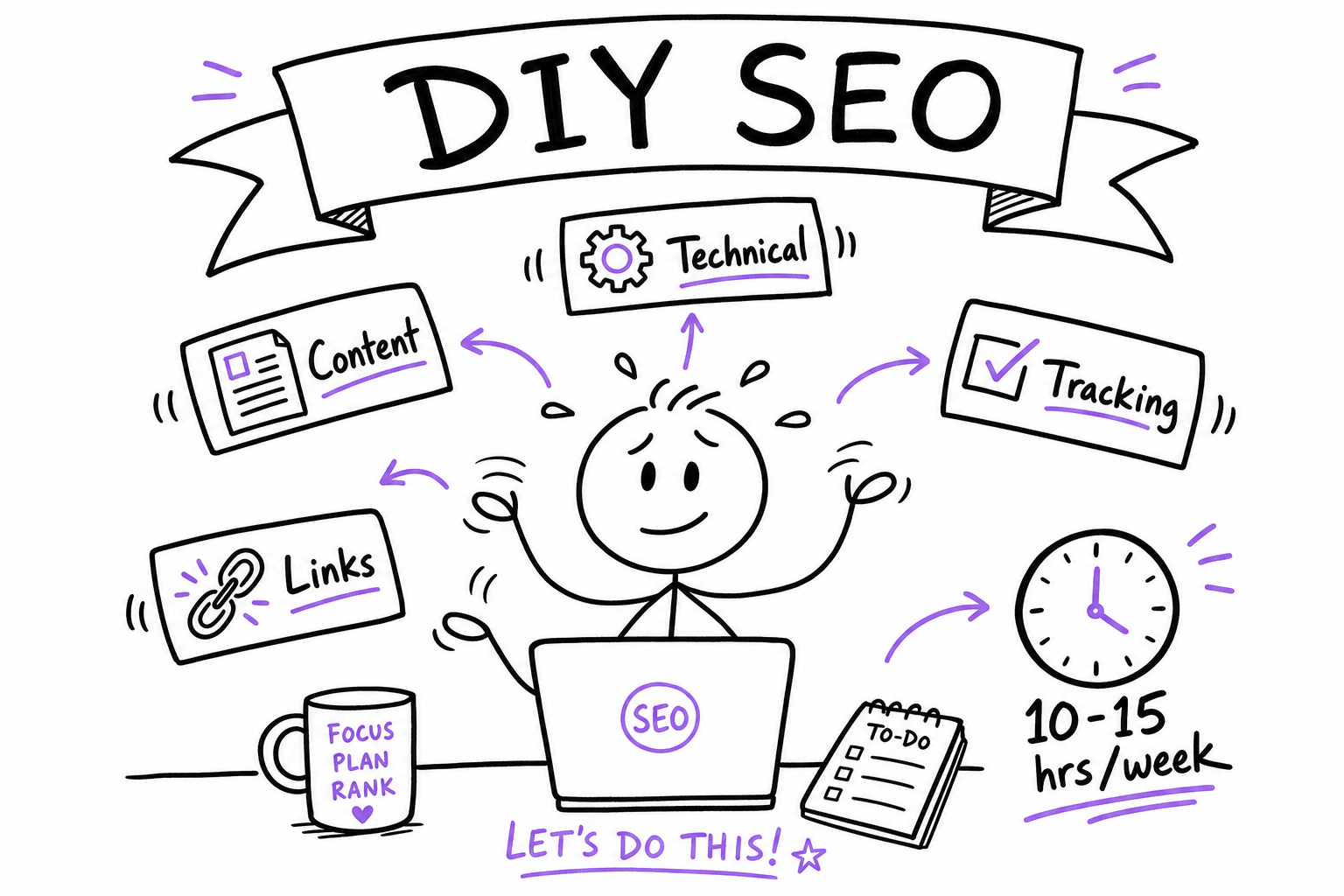
DIY SEO is genuinely doable for a small business, especially when money is tight. You'd be handling: technical fixes (speed, mobile, errors), on-page optimisation (titles, meta descriptions, headings, alt text, internal links), regular content, building local citations and links, and tracking everything in Google Search Console and Analytics.
The good news is the tools can be cheap or free:
- Free: Google Search Console, Google Analytics, Google Keyword Planner, Google Trends, and a free SEO plugin like Yoast for WordPress.
- Paid (optional): a deeper tool subscription. SA market data puts typical DIY tool spend at roughly R900 to R5,500 a month, depending on how much you need.
The real cost of DIY isn't money — it's time. Industry estimates suggest a small business owner needs 10 to 15 hours a week to do SEO properly: a few hours on technical work, several on content, some on links, and the rest on tracking and learning. That's a part-time job on top of running your business. If your hours are worth more spent on customers or sales, "free" DIY isn't really free. DIY also tends to take longer to show results — often six to twelve months of consistent effort. It's the right choice if you have more time than money and genuinely enjoy learning the skill.
The hidden cost most businesses ignore
When comparing DIY SEO to hiring help, most business owners focus on one thing: money.
But there's another cost that's often far bigger — your time.
If you're spending 10–15 hours a week learning SEO, writing content, fixing technical issues, researching keywords, and tracking rankings, those are hours you're not spending on sales, customer service, operations, or actually delivering your product or service.
For some businesses, DIY SEO is the cheapest option. For others, it's the most expensive.
A useful question to ask is: "What is an hour of my time worth?" If your business generates more value when you're serving customers or closing deals, outsourcing some or all of your SEO may be the smarter financial decision — even if it costs more upfront.
Hiring an SEO freelancer in South Africa
If you have some budget but not enough for an agency, a freelancer is the popular middle ground. South Africa has plenty of independent seo consultants who work with small businesses.
On rates, 2024 SA market data puts freelance SEO at roughly R300 to R1,000 an hour — newer freelancers at the lower end, experienced ones above R800. Most work on monthly retainers rather than strict hourly billing, and 2025 SA pricing surveys put ongoing small-business retainers commonly between R3,000 and R12,000 a month, with simple local SEO starting around R3,000–R6,000.
- Pros: lower cost and real flexibility — hire them for a one-off project or month-to-month with no long contract. You usually deal directly with the person doing the work, so communication is fast and personal. A good freelancer can be a genuine specialist in your exact need (say, local SEO).
- Cons: one person has limited bandwidth. They may be strong on content but lighter on technical work, and if you need a lot done at once they can become a bottleneck. Check their track record and make sure they report properly — never settle for someone who just "does stuff" with no transparency.
A freelancer is best when you need focused expertise at a sensible cost and can trade a little speed or breadth for it. Many SA businesses start here to build a solid SEO foundation.
Hiring an SEO agency in South Africa
An seo agency is effectively an outsourced SEO department — powerful, but pricier. Recent SA industry data shows most agencies charge between R8,000 and R25,000 a month for small-to-midsize packages, with entry-level local SEO starting around R5,000–R8,000 and premium national campaigns running R25,000–R45,000+. Most ask for a three-to-six-month commitment, since SEO takes time to work.
- Pros: a whole team of specialists working at once — technical, content, links, analytics — so more gets done, faster. You get structured reporting, regular updates, and access to premium tools. A good agency acts like a strategic partner and suits competitive markets where you need results at scale.
- Cons: the cost is highest (often two to five times a freelancer for similar tasks), you may deal with an account manager rather than the specialists, and a tiny client at a big agency can feel deprioritised. Vet for agencies that actually work with small businesses.
An agency is worth it when SEO is a priority channel, your market is competitive, and you have the budget and growth ambition to justify it.
The hybrid option: DIY + professional help
It's easy to think the choice is either DIY, a freelancer, or an agency.
In reality, many South African businesses get the best results by combining them.
For example:
- You write your own blog content while a freelancer handles technical SEO.
- You manage your Google Business Profile while an agency develops the overall strategy.
- You create content in-house while outsourcing link building or site audits.
- You do the day-to-day work and bring in an expert a few times a year for guidance.
This hybrid approach keeps costs lower while still giving you access to specialist expertise where it matters most.
For many small businesses, it's the sweet spot between affordability and effectiveness.
Honest cost comparison
Here's how the three stack up:
| DIY | Freelancer | Agency | |
|---|---|---|---|
| Monthly cost | ~R0 – R1,500 (tools) | R3,000 – R12,000 | R8,000 – R25,000+ |
| Your time | 10–15 hrs/week | Low | Lowest |
| Speed to results | Slowest (6–12 months) | Medium | Fastest (3–6 months) |
| Best for | Tiny budget, time to learn | Some budget, focused help | Bigger budget, competitive market |
The pattern is simple: DIY is cheapest in rands but most expensive in your time and slowest to pay off; a freelancer is the mid-range sweet spot; an agency costs the most but does the most and saves you the most time. Work out your own hourly value and how many hours you can spare — that usually makes the right choice obvious.
For the full pricing picture across scopes, see our guide: How Much Does SEO Cost in South Africa?
Signs it's time to move up
The right SEO approach today may not be the right one six months from now.
You may want to move from DIY to a freelancer if:
- SEO tasks keep getting pushed aside.
- You're unsure what to work on next.
- Your competitors are outranking you.
- You're generating revenue and can invest in growth.
You may want to move from a freelancer to an agency if:
- SEO has become a major source of leads.
- You need content, technical SEO, local SEO, and link building all at once.
- You're competing in a crowded market.
- You need faster execution and more resources than one person can realistically provide.
The important thing to remember is that SEO isn't an all-or-nothing decision. Most businesses evolve from one option to the next as they grow.
How to vet any SEO provider
SEO has no official accreditation, so you have to vet people yourself. Ask any freelancer or agency these, and the honest ones will answer clearly:
- Can you show results for businesses like mine? Ask for real case studies — traffic, rankings or leads for a comparable client.
- What metrics do you track, and how do you report? Look for organic traffic, ranking changes, and leads or conversions — not just "we'll get you to #1."
- What's your strategy and what's included each month? They should name actual deliverables (e.g. two blog posts, five pages optimised, link outreach), not vague promises.
- Do you stick to white-hat practices? A real pro confirms they follow Google's guidelines — no bought links, no keyword stuffing, no "secret techniques."
- How will we communicate? Know how often you'll get updates and whether you deal with the specialist or an account manager.
Good monthly reporting makes the work visible: a clear list of what was done, ranking changes with context, traffic and leads tied to SEO, any technical issues found, and what's planned next. You should never finish a report wondering "so what did they actually do?"
Red flags and scams to avoid
A few warnings that should make you walk away:
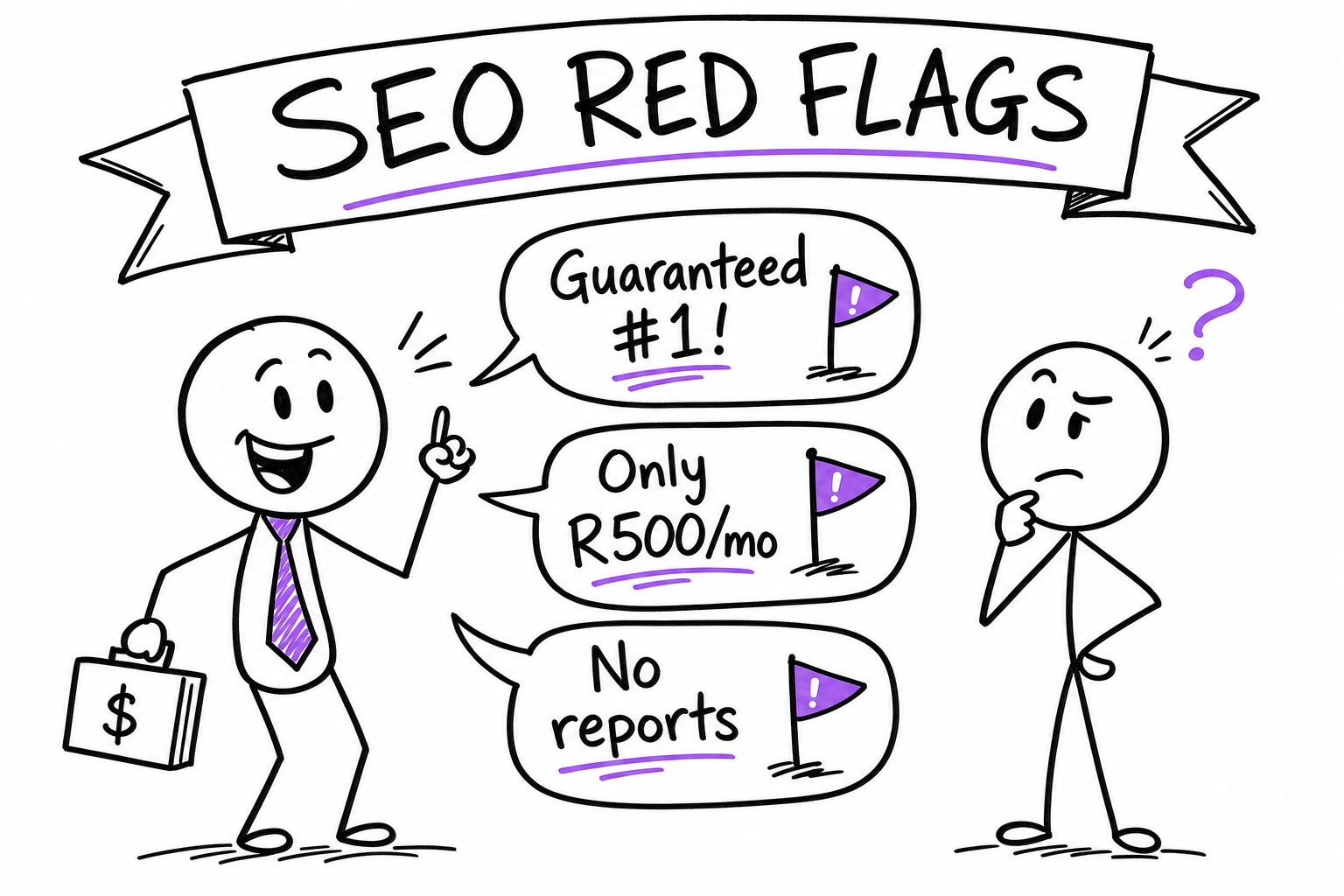
- "Guaranteed #1 on Google." No one can guarantee rankings — Google's own guidelines say so. It's the clearest red flag in the industry.
- Ultra-cheap offers. "Full SEO for R500 a month" usually means automated spam links or nothing real — and cheap SEO can actively harm your site.
- No reporting or transparency. If they won't show you what they're doing, assume nothing useful is happening.
- Black-hat tactics. Bought links, private blog networks, keyword stuffing or auto-generated content can get your site penalised. Quality content and real outreach is the only safe path.
- "Special relationship with Google." There's no such thing. Google gives no SEO company ranking preference.
- Long lock-in contracts with no exit. A three-to-six-month commitment is fair; an unconditional 12-month lock-in with no accountability is not.
Which option fits your business?
A simple way to decide:
- Bootstrapped, more time than money, low-competition market? Go DIY — and treat it as a learning phase that makes you a smarter client later.
- Some budget (about R3k–R10k a month), need steady improvement? A freelancer or a small agency's basic package is the sweet spot — common for SA local businesses and SMEs.
- Competitive industry, scaling up, R15k+ a month to invest? An agency's resources and speed will serve you best.
And it doesn't have to be all-or-nothing — plenty of businesses do their own content in-house while outsourcing technical SEO or link building. Match the approach to your stage now, and change it as you grow.
We're a lean Cape Town studio doing practical, affordable SEO for South African small businesses — direct, transparent, and starting with the local work that pays off fastest. Get a free audit.
Want SEO done properly, without the agency price tag?
We're a lean Cape Town studio doing practical, affordable SEO for South African small businesses — direct, transparent, and starting with the local work that pays off fastest. Get a free audit.
Frequently asked questions
Should I do SEO myself or hire someone?
Do it yourself if your budget is near zero and you have 10–15 hours a week to learn. Hire a freelancer if you have a few thousand rand a month, or an agency if you're in a competitive market with a bigger budget.
How much does an SEO freelancer cost in South Africa?
Roughly R300 to R1,000 an hour, or monthly retainers commonly between R3,000 and R12,000, depending on experience and scope.
How much does an SEO agency cost in South Africa?
Most SA agencies charge between R8,000 and R25,000 a month for small-to-midsize packages, with entry-level local SEO from around R5,000–R8,000 and premium campaigns higher.
Is a freelancer or an agency better?
A freelancer is better value for focused, ongoing help on a moderate budget; an agency is better when you need breadth, speed and scale and can invest more. Neither is "better" in the abstract — it depends on your budget and competition.