If you run a business in South Africa, chances are you've heard the term "SEO" more times than you can count. Maybe a web designer mentioned it when building your website. Perhaps a marketing agency told you that your rankings need work. Or maybe you've wondered why your competitors keep appearing on Google while your business doesn't.
The problem is that SEO is often explained in overly technical language or wrapped in marketing buzzwords. For many business owners, it ends up sounding complicated, expensive, and difficult to measure.
In reality, SEO is much simpler than most people think.
At its core, SEO (Search Engine Optimisation) is the process of helping your business appear when potential customers search for the products or services you offer. Whether someone is looking for a plumber in Cape Town, a lawyer in Johannesburg, an online store in South Africa, or a web design agency near them, SEO helps connect those searches with the businesses best suited to meet their needs.
But does your business actually need SEO? How does Google decide which websites appear first? What work is actually involved? How long does SEO take? What does it cost? And should you do it yourself or hire a professional?
This guide answers those questions in plain English. No jargon. No exaggerated promises. No sales pitch.
By the end, you'll understand what SEO really is, how search engines rank websites, the work involved behind the scenes, realistic timelines and costs, and how to decide whether SEO is the right investment for your South African business.
What is SEO?
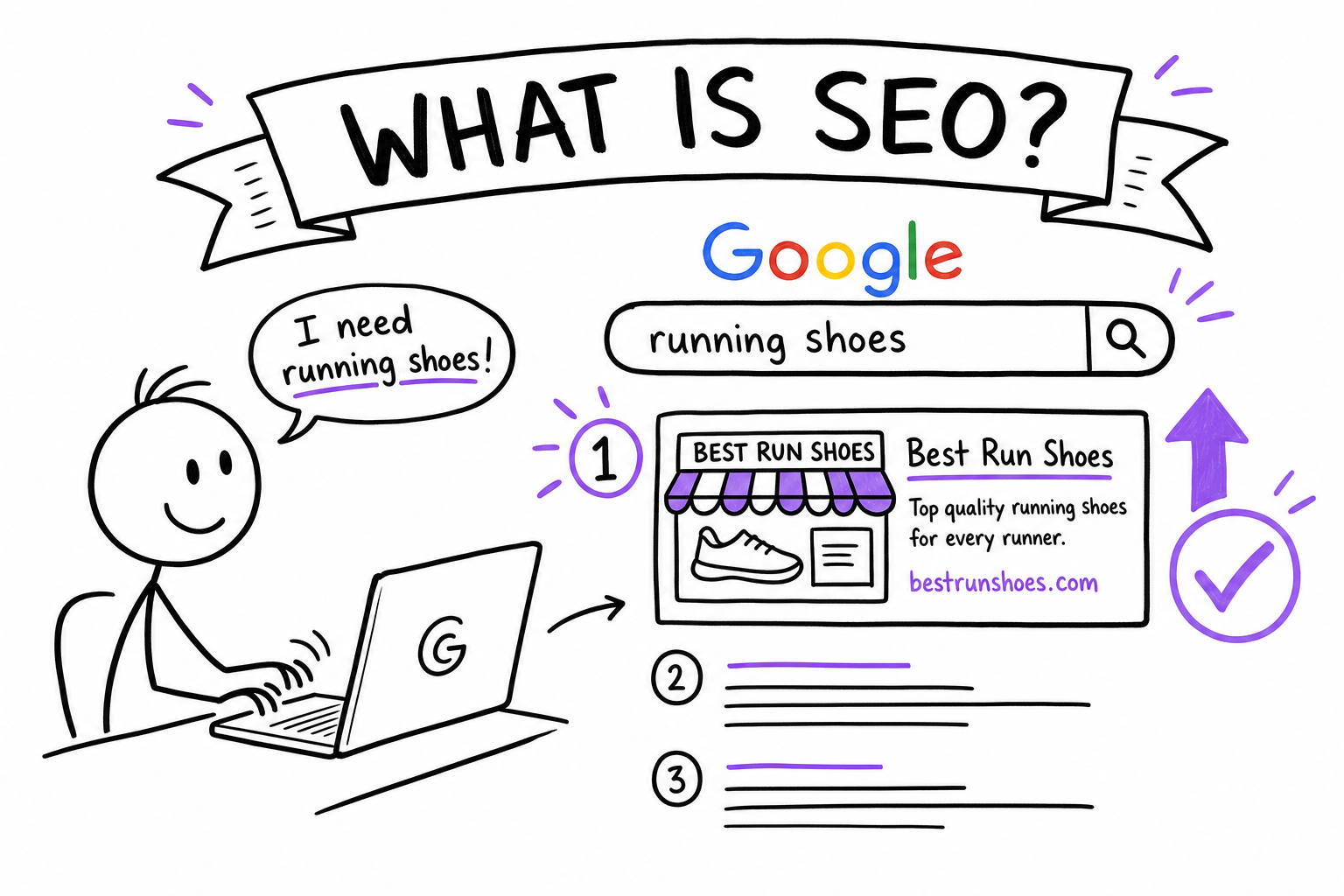
SEO (search engine optimisation) is the work of getting your website to show up higher in Google's normal, unpaid search results — so the people searching for what you sell find you instead of a competitor. Semrush puts it simply: SEO is about improving your site so it appears more in organic (unpaid) search, without paying for ads.
That's the whole idea. When someone types "plumber in Somerset West" or "affordable accountant near me" into Google, there's a list of results. SEO is everything you do to be one of the businesses near the top of that list — for free, every time someone searches, without paying per click.
It helps to know how SEO works at a high level: Google's job is to give the searcher the most useful answer. SEO is the work of making your site that answer — genuinely relevant, helpful and trustworthy — so Google chooses to show it.
Why SEO matters for a small business
Search is usually where buying starts. Someone with a problem types it into Google, and the businesses that show up get the call. The traffic SEO brings is different from almost any other marketing: these are people actively looking for what you offer, right now, at the moment they're ready to act.
Three reasons it's worth it for a small business:
- The intent is high. Someone searching "emergency electrician Cape Town" isn't browsing — they want to hire today.
- It compounds. Unlike an ad that stops the second you stop paying, a page that ranks well keeps bringing in enquiries for months, even years.
- It levels the field. A small business that does SEO properly can outrank bigger, lazier competitors in local search — because plenty of them still neglect it.
Does your business actually need SEO?
Not every business needs SEO immediately.
If most of your work comes from repeat customers, referrals, or long-term contracts, SEO may not be your highest priority right now.
However, if people regularly search Google for the products or services you offer, SEO is often one of the most cost-effective ways to generate new enquiries over the long term.
A simple rule of thumb:
- If customers search for what you sell, SEO matters.
- If customers don't search for it, other channels like networking, referrals, partnerships, or direct outreach may deserve more attention.
For most South African service businesses, trades, professional services, e-commerce stores, and hospitality businesses, appearing on Google when people are actively looking to buy is usually worth the investment.
How Google decides what ranks
Google uses hundreds of signals, but for a small business it really comes down to a handful. According to Google's own "How Search Works" explanation, its systems weigh the words of your query, the relevance and usability of pages, and the expertise of sources, among other things. In plain terms:
- Relevance — how well your page matches what the person actually searched for.
- Helpful, quality content — pages that genuinely answer the question, not thin filler stuffed with keywords.
- Trust and expertise — Google's quality guidelines lean heavily on what it calls E-E-A-T (experience, expertise, authoritativeness and trustworthiness); content that shows real, first-hand knowledge does better.
- Links and reputation — when other reputable sites link to yours, Google treats it as a vote of confidence. Google's original PageRank idea, still part of its core ranking systems, was built on exactly this.
The takeaway: be the most relevant, genuinely useful, trustworthy answer to the search — and Google rewards you with visibility. There's no trick that beats that for long.
The three parts of SEO
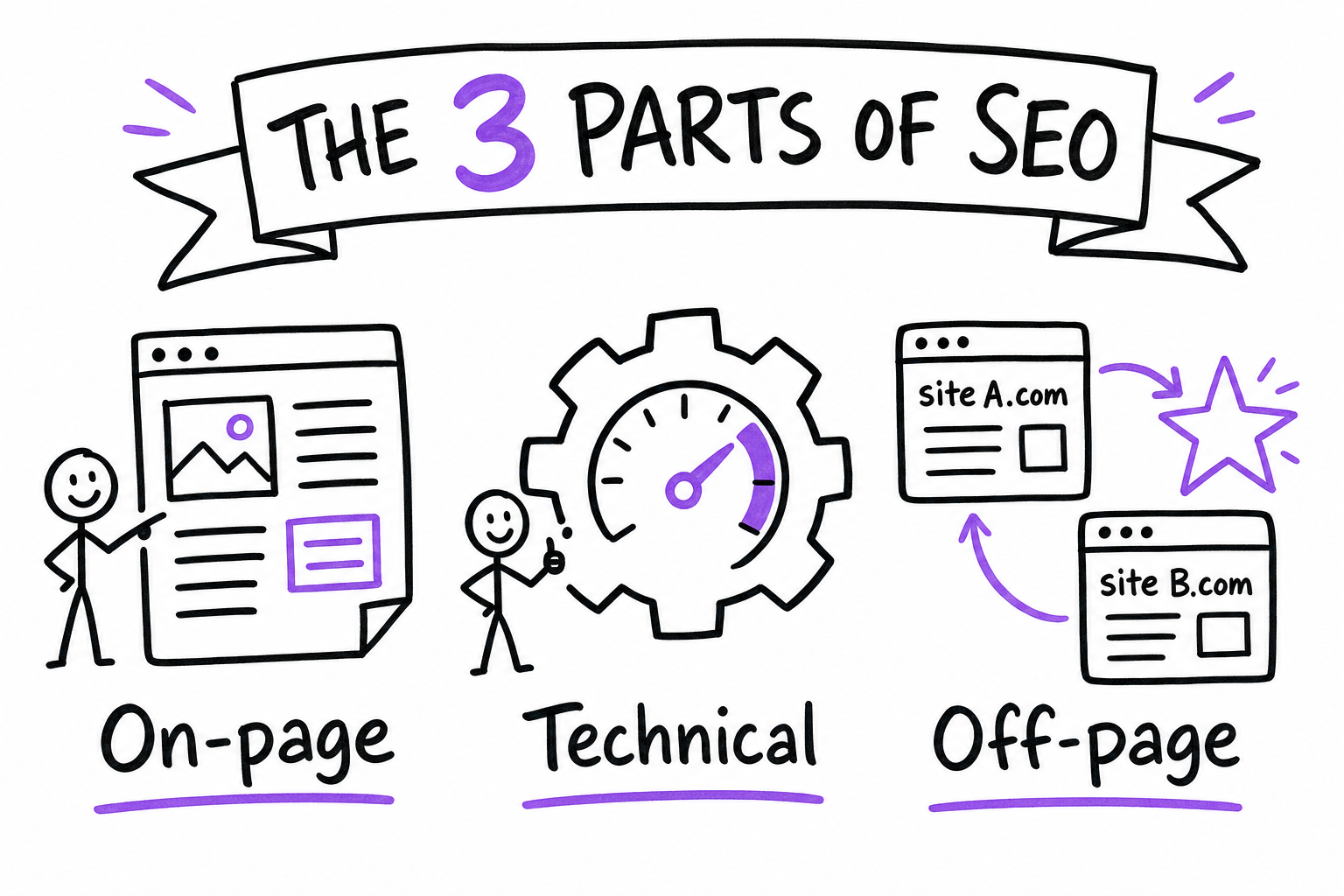
SEO is usually split into three areas that work together. Understanding them makes everything else click into place.
- On-page SEO — the work on your pages: useful content, the right words, clear titles and headings, helpful images, sensible internal links. It's making each page genuinely answer what people search for, and making it obvious to Google what the page is about.
- Technical SEO — the behind-the-scenes foundation: a fast, mobile-friendly, secure (HTTPS) site that Google can easily crawl, render and index. If Google can't read your site properly, none of the rest matters.
- Off-page SEO — your reputation off your site: links from other websites, online reviews, business listings and mentions. These are the external signals that tell Google you're known and trusted.
Think of it as a shop: on-page is your products and signage, technical SEO is the building and the doors that actually open, and off-page is your word-of-mouth reputation around town.
On-page SEO, a little deeper
On-page is where most small businesses win or lose. It means writing content that answers real questions, putting your main keyword in the page title and headings, using clear URLs, adding descriptive alt text to images, and linking sensibly between your own pages. None of it is technical wizardry — it's mostly clear, useful writing aimed at a real reader.
Technical SEO, a little deeper
Technical SEO keeps the foundation sound: fast loading, a mobile-friendly layout (Google indexes the mobile version of your site first), an SSL certificate for HTTPS, a tidy site structure, a sitemap, and no broken links or crawl errors. You don't need to obsess over it, but a slow or broken site quietly caps everything else.
Off-page SEO, a little deeper
Off-page is about earning trust beyond your own pages: getting other reputable sites to link to you, collecting genuine reviews, and keeping consistent business listings. For a local business, a single link from a respected local site or a steady stream of Google reviews can move the needle more than months of tweaking.
Keyword research: where SEO starts
Before any of that, you need to know what your customers actually type into Google. That's keyword research — finding the real phrases people search, and how often. It's the difference between writing what you think matters and writing what customers are actually looking for.
For a small business it's straightforward: list the services you offer, imagine how a customer would search for each, and check which phrasings are most common. Then build pages and posts around those exact phrases. The closer your page matches the real search, the better your chance of ranking.
What "SEO services" actually include
When you pay someone for seo services each month, you're paying for ongoing work — not a once-off. SEO isn't "set and forget." A good provider of search engine optimisation services typically handles:
- An audit and strategy — where you stand now and the plan to improve
- Technical fixes — speed, mobile, errors, indexing
- On-page updates — content, titles and meta tweaks to match what people search
- Content — new pages and posts targeting the things your customers look for
- Local SEO — your Google Business Profile and reviews, if you serve an area
- Off-page work — earning quality links and mentions
- Reporting — a monthly update on rankings, traffic, and exactly what was done
If a provider can't tell you which of these you're getting each month, that's a red flag.
SEO vs Google Ads — what's the difference?
Both get you onto Google, but in very different ways:
| SEO (organic) | Google Ads (PPC) | |
|---|---|---|
| How you pay | Time or service fees, not per click | You pay for every click |
| Speed | Builds over 3–6 months | Instant — top of page in hours |
| When you stop | Keeps working for months | Disappears the moment you stop paying |
| Best for | Long-term growth and trust | Quick wins, launches, testing |
As SEO.com describes it, the difference is simple: with SEO you earn unpaid traffic by improving your site; with Google Ads you pay for placement in the sponsored spots. Think of it like property — SEO is buying a home (slow to build equity, but lasting), and Ads are renting (instant, but only while you keep paying). Most small businesses do best using SEO for the long game and Ads for short bursts: a sale, a launch, a new offer.
How long does SEO take?
The honest answer is months, not days. According to Ahrefs, who polled a large number of SEO professionals, it typically takes three to six months to see meaningful gains in rankings and traffic. Google itself advises patience, saying it's reasonable to expect anywhere from four months to a year to see the benefit of SEO changes.
Why so long? Google needs time to discover your changes, index your content, and judge where you belong against competitors. A brand-new website sits at the longer end of that range; an established site usually moves faster. The good news, as most SEO practitioners will tell you, is that it compounds — once you build momentum and trust, later gains tend to come quicker, and the traffic keeps coming without paying per click.
One warning: if anyone promises "#1 on Google in two weeks," walk away. SEO is a marathon, not a sprint, and guaranteed instant rankings are the clearest red flag in the industry.
What does SEO cost in South Africa?
SEO costs vary widely depending on your goals, competition, and who does the work.
A small local business might spend a few thousand rands per month on basic local SEO, while a business competing nationally could invest significantly more in content, technical improvements, and link building. The important thing to understand is that SEO isn't a product you buy once — it's ongoing work that builds visibility over time.
The cheapest option isn't always the best value either. A low-cost provider doing very little each month can end up costing more in lost opportunities than a properly executed campaign.
If you'd like a detailed breakdown of pricing, packages, and what you should expect at each budget level, see our full guide: How Much Does SEO Cost in South Africa?
Local SEO vs general SEO — which should you focus on?
If your business serves a specific area, start with local seo services south africa — the work that gets you found by nearby customers. Local SEO is what puts you in the Google Maps "map pack" when someone searches "near me," and it's usually faster and cheaper to win your town than to rank across the whole country.
A simple way to see it: general SEO helps anyone, anywhere find your website; local SEO helps people in your area find your business. A Johannesburg boutique should own "boutique in Johannesburg" before chasing "women's clothing" nationally — the local search has stronger buying intent and far less competition.
If you sell online to the whole country (or beyond), general SEO is the priority instead — content and keywords aimed at your audience wherever they are. Most local businesses get the best return starting local, then widening. Our full guide goes deeper: local SEO for South African small businesses.
DIY, freelancer, or agency?
There are three ways to get SEO done, and the right one depends on your budget, time and how competitive your market is:
| Option | Rough cost | Best for |
|---|---|---|
| Do it yourself | Lowest (mostly your time) | Tiny budget, willing to learn, very small site |
| Freelancer | Middle | One focus area (e.g. local), moderate budget |
| Agency | Highest | Broad, ongoing, competitive markets |
Doing it yourself saves cash and gives you full control, but SEO has a steep learning curve and eats hours you may not have. A freelancer is the middle ground — affordable, focused, often a specialist in one area like local SEO.
An agency brings a whole team (technical, content, links) for bigger or more competitive needs, at the highest cost. Many businesses start DIY, then bring in a freelancer or agency as they grow. Whichever you choose, insist on quality content and clean, honest practices — never "black hat" shortcuts that can get you penalised.
Common SEO mistakes to avoid
A few traps that quietly sink small-business SEO:
- Keyword stuffing — cramming the same phrase unnaturally. Google sees through it and it reads badly to humans.
- Thin, copied content — pages that don't genuinely help. Google's "helpful content" focus punishes filler.
- Ignoring mobile and speed — a slow site on phones loses both rankings and customers.
- Chasing tricks over substance — buying spammy links or believing "guaranteed #1" promises. Short-term at best, penalties at worst.
- Giving up at month two — SEO needs a few months to show; quitting early wastes the work you already did.
How to measure if SEO is working
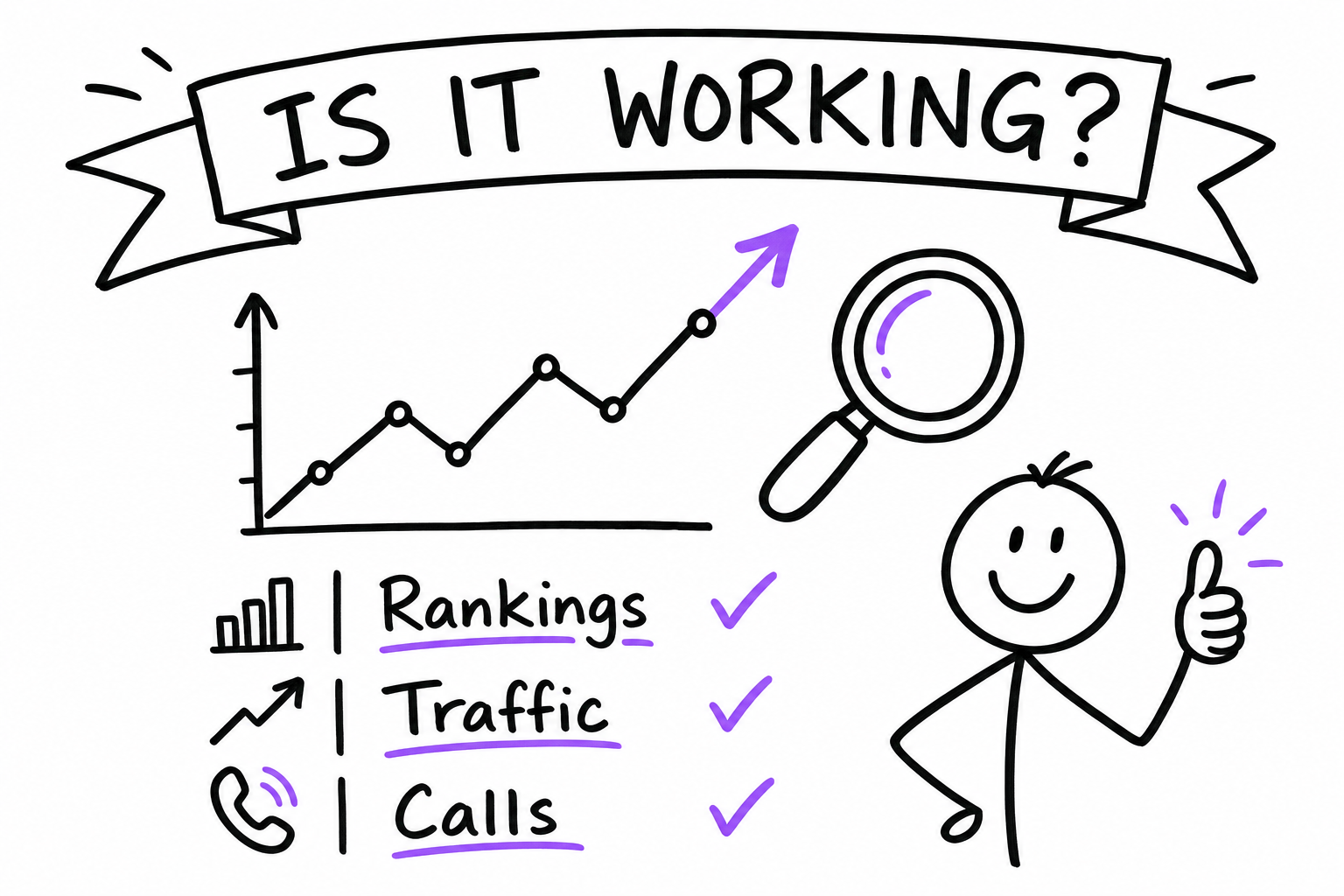
You don't have to guess. The signals that matter are free to track: your rankings for the "service + town" searches you care about, your organic traffic and which pages bring it, and — most importantly — the enquiries, calls and sales that result. Google's own tools (Search Console and Analytics) show most of this for free, and your Google Business Profile shows calls and direction requests for local searches.
Not sure where you stand right now? Our free Google Visibility Checker gives you a quick read on how visible your business is on Google — a good 30-second starting point before you spend anything.
SEO in South Africa: what's different
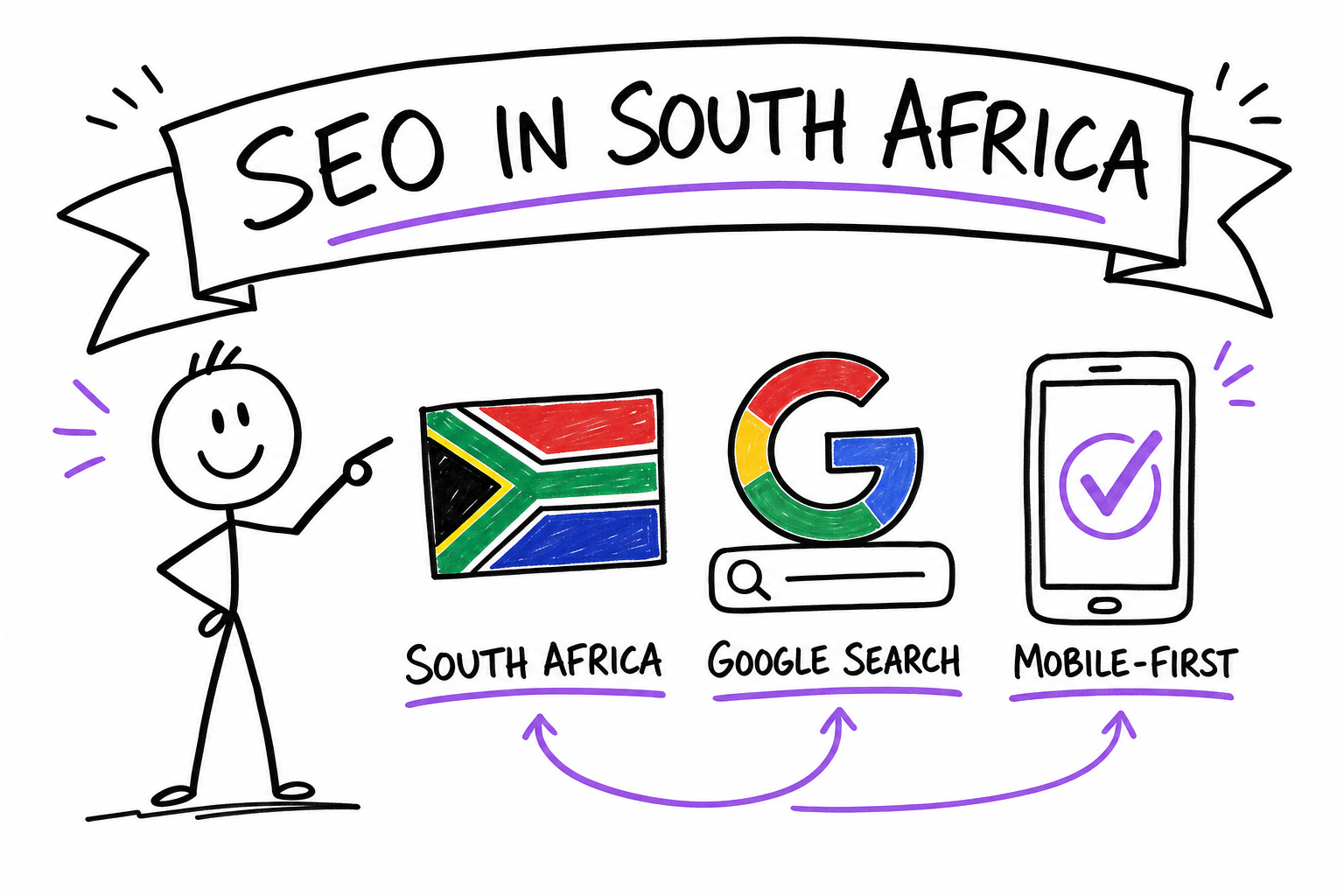
The principles above are universal, but a few things matter more here:
- Google is almost everything. According to StatCounter, Google holds roughly 93% of the South African search market — so optimise for Google first (Search and Maps); Bing and the rest are a rounding error locally.
- Mobile-first is non-negotiable. StatCounter data shows the majority of South African web traffic is on phones, and Google indexes the mobile version of your site — so a fast, mobile-friendly site isn't optional. A lighter, faster site also respects visitors on limited data.
- Local signals help. A .co.za domain, your address on the page, and listings on local directories like HelloPeter and Brabys all tell Google you're a genuine South African business.
- Language and context. South Africa has eleven official languages; if your customers search in Afrikaans or isiZulu, some content in that language can be a low-competition advantage. Use local spelling and rand prices so your content reads as genuinely local.
The encouraging part: plenty of South African competitors still don't do SEO properly, so a small business that does can punch well above its weight in local results.
Getting started
You don't need a big budget to begin. In order: make sure your site is fast and mobile-friendly, claim and complete your Google Business Profile if you're local, write a few genuinely useful pages around the exact phrases your customers search, and start earning reviews. Those basics put you ahead of most small competitors — then you decide whether to keep doing it yourself or bring in help.
If you'd rather not wrestle with it, that's exactly what we do — practical, affordable SEO that starts with the local work that brings the fastest return.
We do practical, affordable SEO for South African small businesses — starting with the local work that brings the fastest return. Get a free audit and a plain-English plan.
Want to actually get found on Google?
We do practical, affordable SEO for South African small businesses — starting with the local work that brings the fastest return. Get a free audit and a plain-English plan.
Frequently asked questions
What is SEO in simple terms?
SEO (search engine optimisation) is the work of getting your website to show up higher in Google's free, unpaid search results, so people searching for what you offer find you instead of a competitor.
How does SEO work?
You make your site the most relevant, helpful and trustworthy answer to what people search — through useful content (on-page), a fast, crawlable site (technical), and a good reputation in links and reviews (off-page). Google then ranks you higher for those searches.
Is SEO worth it for a small business?
Yes — especially local SEO. It brings people who are actively searching for what you sell, and unlike ads it keeps working after you stop paying. It just takes a few months to build.
What's the difference between SEO and Google Ads?
SEO earns free, organic rankings over time; Google Ads pays for instant placement that stops when your budget does. Most small businesses use SEO for the long term and Ads for quick bursts.
How long does SEO take to work?
Usually three to six months for meaningful results — sometimes up to a year for a brand-new site. Anyone promising instant #1 rankings isn't being honest.
Can I do SEO myself?
You can do the basics — a fast mobile site, a complete Google Business Profile, useful pages and reviews. It takes time and a learning curve, so many owners eventually bring in a freelancer or agency as they grow.
How much does SEO cost in South Africa?
It varies by scope — see our full breakdown in how much SEO costs in South Africa.